Long before Nigel Farage took aim at Brussels, a different kind of foreign threat was being charted in British minds. In the sixth century, Nennius of Historia Brittonum, musing on Britain’s origins, traced its lineage to the mystical first king of Britain, Brutus of Troy, who in turn was a descendent of none other than Japheth, son of Noah. This genealogical ambition might have been flattering had it not meant a certain monstrous heritage: Japheth’s other son included Magog, a mythic giant whose evil children, together with those of Gog, were destined to emerge at the end of days to wreak havoc upon the earth. For the British, then, monstrosity isn’t just a story. It is family tradition.
Geoffrey of Monmouth picked up this tale in the twelfth century, introducing Gogmagog, a colossal, uncivilised beast bested by the hero Brutus, who declared Britain’s independence from monsters by hurling Gogmagog into the sea. It was a lesson as old as the Isles themselves: if you’re going to keep your borders monster-free, start with a decisive toss.
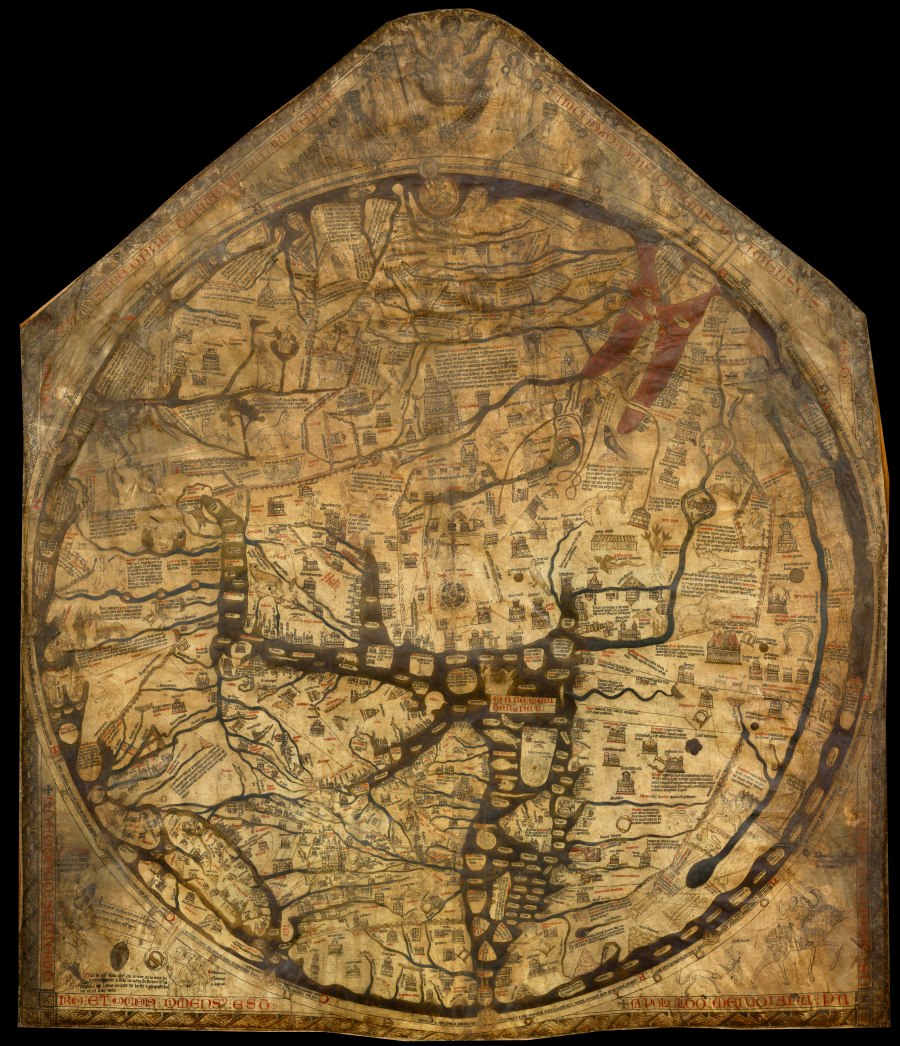
In the medieval world, maps depicted a known realm bound by Europe, Africa, and Asia. But just as the Earth ended, the monsters began. The edges of these maps were populated by terrifying creatures: fire-breathing dog-men, headless warriors, and worm-like barbarians whose mere existence, it seemed, was a cautionary tale for any traveller daring enough to wander too far. Britain, a geographical outlier tucked at the fringes of the known world, could not escape this perception. The British Isles, perched at the edge of civilisation, became the world’s margin, adorned with its own grotesque inhabitants, both monstrous and mystical. The Anglo-Saxons, with their fondness for grim legends, began to see their own lands as teeming with monsters, both mythical and man-made.
The British imagination readily embraced this monstrosity. Gildas, a sixth-century monk, described the Anglo-Saxons as “wild beasts,” portraying their enemies as “filthy hordes,” wriggling “like dark troops of worms” across the land. Similarly, Nennius associated the British and Anglo-Saxon genealogies with giants like Gog and Magog, monstrous beings who had to be vanquished for the nation to flourish. Such tales set the stage for Britain’s self-image as a stronghold against forces of chaos, with the island itself serving as a final, fragile barrier before the civilised world collapsed into the monstrous unknown.
This blend of pride and apprehension echoed through British history. Geoffrey of Monmouth painted Britain’s original inhabitants as wild giants needing to be conquered before civilisation could thrive. By the time the Age of Exploration dawned, Britain’s explorers were hesitant to venture out until the Spanish and Portuguese had charted more of the world’s edges. True to form, Britain preferred a strategic approach, advancing cautiously and claiming land only once it was reasonably certain no monsters lurked there. Then, having cautiously staked its claims, Britain calmly painted vast swathes of the world.
As the centuries passed, Britain’s mythical monsters may have faded, but they left behind a peculiar national mindset. The British mind became a fortress, cautiously peering over the parapet to survey the landscape, whether the giants beyond its borders were literal or bureaucratic. In the British psyche, monsters are as much about identity as about danger. Far from being mere beasts lurking in the unknown, these foreign creatures came to symbolise everything the British were not. Whether ogres from legend or regulators from Brussels, monsters are a convenient foil against which Britain defined itself. It is a delicate balance, then, a sort of national neurosis combining curiosity, apprehension, and that distinct British pleasure of maintaining just enough distance to avoid getting involved.
One could say that the British didn’t fear monsters so much as they cultivated them. While others might banish threats outright, Britain found a curious comfort in the notion of existential risk. It’s as if the nation has never been quite comfortable without something dark and foreign looming just beyond the horizon, a perpetual menace that validates its sense of distinctness. But rather than confront the beast head-on, the British preference has always been for the genteel retreat, with a slightly indignant huff about the indignities foisted upon this “sovereign isle.”
Consider Brexit, the quintessential reimagining of Britain’s age-old edge-of-the-world anxieties. It wasn’t a rejection out of fear or even spite but a matter of principle; a desire, if you will, to keep Europe at a respectful distance. For the British, the Brussels brigade was not particularly fearsome. After all, why invite foreign managers into one’s house when one’s own monsters are quite enough to manage? Europe, with its endless policies and shared standards, was the kind of meddlesome presence that only blurred the clarity of Britain’s solitary self-image. Better to keep the island unencumbered, free to define its own peculiarities without outside interference.
So where does this leave us? Britain, despite its best efforts, is not quite as calm and collected as it likes to appear. The very act of imagining monsters at the edge of the world speaks to a deeply ingrained fear of the unknown, and an equally strong need to assert control over it. This, perhaps, explains the country’s long-standing reluctance to fully embrace “Europe”. Better to stay at the edge, looking out at the sea, than to venture into a continent filled with real and imagined threats.
For beneath the bluster about sovereignty lies a conviction, stubborn as an English oak, that Britain is not merely independent but pre-eminent. The British don’t despise Europe so much as they delight in standing apart from it. It’s a heady mix of pride and polite indifference; a reassurance that whatever monsters loom across the Channel, they’re best left out of sight, far enough away to maintain the necessary mystique of Britain’s lone, heroic pose at civilisation’s edge.
In the end, Britain’s monsters are both mirrors and masks. They provide a reassuring sense of boundary, a way to define where “we” end and “they” begin. And this perhaps is the most British feature of all: a love affair with the edge, a fondness for peering over the rim without ever taking the leap. Perhaps, the only thing the British dread more than monsters is the possibility that there might, in fact, be none at all.
Further reading
Cohen, Jeff, Of Giants: Sex, Monsters, and the Middle Ages. Minneapolis: University of Minneapolis Press, 1999.
Edson, Evelyn, Mapping Time and Space: How Medieval Mapmakers Viewed Their World, London: The British Library, 1997.
Geoffrey of Monmouth, The Historia Regum Britannie of Geoffrey of Monmouth, ed. Neil Wright. Cambridge: D. S. Brewer, 1984.
Mittman, Asa Simon, Maps and Monsters in Medieval England. New York: Routledge, 2006.
Nennius, British History and the Welsh Annals, ed. John Morris. London: Phillimore, 1980.
Yorke, Barbara, The Anglo-Saxons. Stroud: Sutton, 1999.
 Of Maps and Monsters